
| Index | At Your Service |
|
| Links : Steps & Dances | Party directory | Central Home | About Com |
Boys gives you a lead to the world of Dance. You'll find further information about dancing with the links above. When you for example take dancing lessons, you are quite often expected to know the introduced things in forehand. 18th Feb 2014 : 4/4 time signs were added to text.
The very basic question in dancing is "Who is in charge ?" Usually it is a man, who is in charge and leads the couple. This leads to a thing, that men usually dances forwards and women take steps backwards.
What kind of dances there are ?
There are lots of dances, but the most useful dances are Foxtrot and Waltz.
With these two dances you can dance almost all kind of music. Foxtrot is the most popular, easy to learn and it suits to the most common time signature of the music, which is 2/4 ... or 4/4 depending on source, and the way you count the steps. The Waltz has unique 3/4 time signature.
Besides waltzes and very old classic music, the music is usually done with the signature 2/4. 2/4 suits also to 4/4 steps. Dances ( besides waltz) have also signatures 2/4 or 4/4 : The steps you take on the floor are adapted to the 2/4 or 4/4 signature.
 |
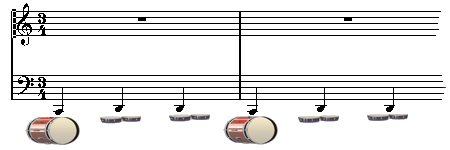 |
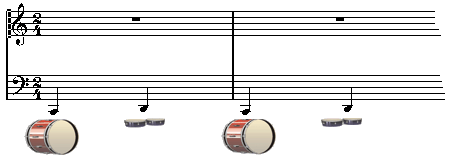
In the pictures you see the basic 2/4 and 3/4 drumming-rhythmic systems. In both pictures there are two cycles. In 2/4 rhythm these two cycles make the total 4/4. The big drum begins the cycle and smaller accompanies. Time signature has nothing do with the speed of the song and dancing. The speed of the song comes from tempo, which is not marked to staff. When tempo is 180 the picture in the left has 90 big drums in one minute, and in the right there are 20 big drums in one minute. When tempo is 60 BPM there are 30 kicks in the left and 10 kicks in the right. When we convert the numbers to dancing, 2/4 song with 180 BMP tempo needs 90 stepping sequences. In dancing you start the cycle by moving one feet, and in the middle of the cycle you move the another foot. In waltzes you should take three steps per cycle.
The commercially drummed songs do not follow the diagrams. In most songs, the bass drum begins the cycles. Usually there is one additional snare hit somewhere in the cycle. In Space Covers We play Rihanna's song "What's my name" twice. The latter "What's my name" is played with the original commercial drumming. "What's my name" [DWTS-mix] is played with standard drumming.
What is time signature ?
In general, the signature ( also known as time ) tells what kind of a drum the drummer hits. When time to hit the drums comes.
The songs are always divided into the 1/4 length signature pieces. The time signature says how many 1/4 pieces there are in a single tempo cycle.
Cycles always begin with the strong stroke. It is played with the bass drum, which is kicked* with the foot. The other 1/4 pieces of the cycle are weaker, played with drumsticks.
The dance steps are always taken at the beginning of every 1/4 time signature. At the same time, the drummer hit the drums. In most dances you make different kind of steps with strokes and ordinary signatures.
The distributor of the time signature, which is almost always 4, affects to the speed of the song. From some experimental songs you can find a distributor, which is not 4.
What is cycle ?
Cycle can be said to be the drumming sequence. Closely related to signature. The cycle begins with a kick to the bass drum. Then comes the weaker hits, which are made with sticks. There is one weaker hit in 2/4 signature music, and two in 3/4 waltzes.
What is tempo ?
Tempo is another dance related musical term. It tells how often the drummer hits the drums.
Tempo is the length of a single 1/4 time signature. The unit Beats per Minute ( BPM ) tells how many time signatures there are in a minute. If tempo is 60 and time signature is X/4, there are always exactly 60 1/4 signatures in the minute.
If tempo is 180, then there are 180 1/4 signatures in the minute.
When the time signature of the actual 60 BPM song is 2/4, then there are only thirty 2/4 cycles in the minute : There are two 1/4 signatures in a single cycle of the 2/4 song.
And if the 60 BPM song is waltz, then there are only twenty 3/4 cycles in a minute Waltz has three 1/4 signatures in a single 3/4 cycle. This only an example, Waltzes are usually very fast songs. Waltz tempo's are around 200 BPM.
Steps ?
There are two basic types of steps. Type one reminds walking, you move with the step. In type two you stand still and move your feet together.
All dances are combinations of these two basic steps. The dances differ from each other with the sequence and positions, where the feet are placed.
In some quite rare dances, you have to jump.
In the elder rock'n'roll dances the stepping is sometimes replaced with bodily action. You wave your hands, shake your bottoms, bend your knees and so on.
The disco / techno music has two-to-three step types. When the song is slow and romantic, and you are dancing with a stranger, you dance the song with the basic foxtrot steps. In romantic songs you are so close to your partner, that without predefined steps you would stepping on your partners toes all the time. This is the only rule disco dancing has.
When you are dancing romantic song with someone close to you , you are very close to each other. You do not move very much, and if you do, the female partner quite often stands on the partner's feet. In the fast songs you keep distance to your partner, and improvise the steps almost all by yourself.
More detailed information about the steps of the individual dances can be found with the links above.
How to study ?
On the dance floor, with skilled partner / teacher. In dance schools.
At home with skilled partner / teacher. One of the easiest way to learn, is to mark the steps on the floor and follow them. You can also spread a carton or rug, with preprinted steps, on the floor.
How to get the rhythm ?
When you dance, you should never concentrate yourself with the singer and the lyrics. Instead you should set your ears to the low frequencies and background voices.
The drums, the bass, percussion and other things, that are played in the low frequencies follow the rhythm. And if the song is made for dancing ( and for other physical activities ), all you have to do is to follow the drums.
If the ballroom, restaurant or disco has a good DJ or performing artist, almost all the songs which are played, are either made or arranged for dancing.
When time is 2/4, there are two hits in the single tempo. The bass drum hits the number one, and a smaller drum makes the second hit. These hits match to the diagrams and instructions of the dance steps. Sample from the steps would go : cross step - step.
When time is 3/4, there are three hits in the single tempo. The bass drum hits first, and then a smaller drum makes the second and the third hits. These hits match to the diagrams and instructions of the dance steps. Sample from the steps would go : cross step - step - step
When time is 4/4, there are four hits in the single tempo. The bass drum hits the number one, and a smaller drum makes the second, third and fourth hit. These hits match to the diagrams and instructions of the 4/4 dance steps. 4/4 steps can be danced with 2/4 music. And example from steps would be cross step - step - step - step.
Sometimes 4/4 sign is counted from the steps : cross step - right step and cross step - left step. When you dance steps like these, you need music with 2/4 time sign. You must take the cross steps with the same drum.
If you dance classical music, like Wiener Waltz, the rhythm is usually played with cellos and contrabasses. And sometimes with tubas.
But the drummer didn't follow the instructions !
In almost every song there are non sequenced drum sections. The tempo and also the signature of the song usually remains the same during the non sequenced parts of the songs. After a while the drummer returns to the base rhythm. Good dance songs always start with app 10 second introduction to the rhythm. You can hear the rhythm very clearly. Sometimes the introduction is played with drums only. In live performance, the introductions to the rhythm are almost always played with drums.
If the song is not made for dancing, then the formula is slightly different. It is much more difficult to find the right rhythm. The rhythm is played with various instruments, and sometimes it is totally lost.
From these songs you might find short drumming sequences, which tells the rhythm to you with basic 1-2-1-2-1 hits. As an example of a record like this, Madonna's Confessions on the dance floor, can be mentioned. The name of the record is almost the only thing that refers to the dancing. There aren't very many rhythm sequences in the songs.
The classic disco music from the 70's and 80's is the most easiest dance music, the drums are playing the rhythm almost all the time. And that's not all almost all hits had also special dance mix versions for disco's, ballrooms and others.
Boys
? 18th Feb 2014 : Time signs of the dance are not very coherent. They are said to be this and that. When you make music, doing song to 2/4 tempo quarantines that song suits to all dances with either 2/4 or 4/4 time sign. It is also the way songs are usually arranged.
- When writing this note, we have worked with app 80 arrangements, made by various persons. Seen all kinds of drumming sequences, never seen a song / arrangement which would have a real 4/4 time sign.
- Closest common match is a sequence we call "2/4 waltz". In 2/4 waltz, first part has one hit with bass drum. In the second part snare starts and it hits second time in the middle. It would go like this 1 - + 2 2, 1 - + 2 2, etc* Kicking of the bass drum is only a term. When drummer kicks the drum, he pushes the pedal-lever-system, which hits the bass drum with drumstick like gadget.